Understanding Records of Life
Life leaves chemical traces in rocks. We figure out how those traces are produced and what information they carry.
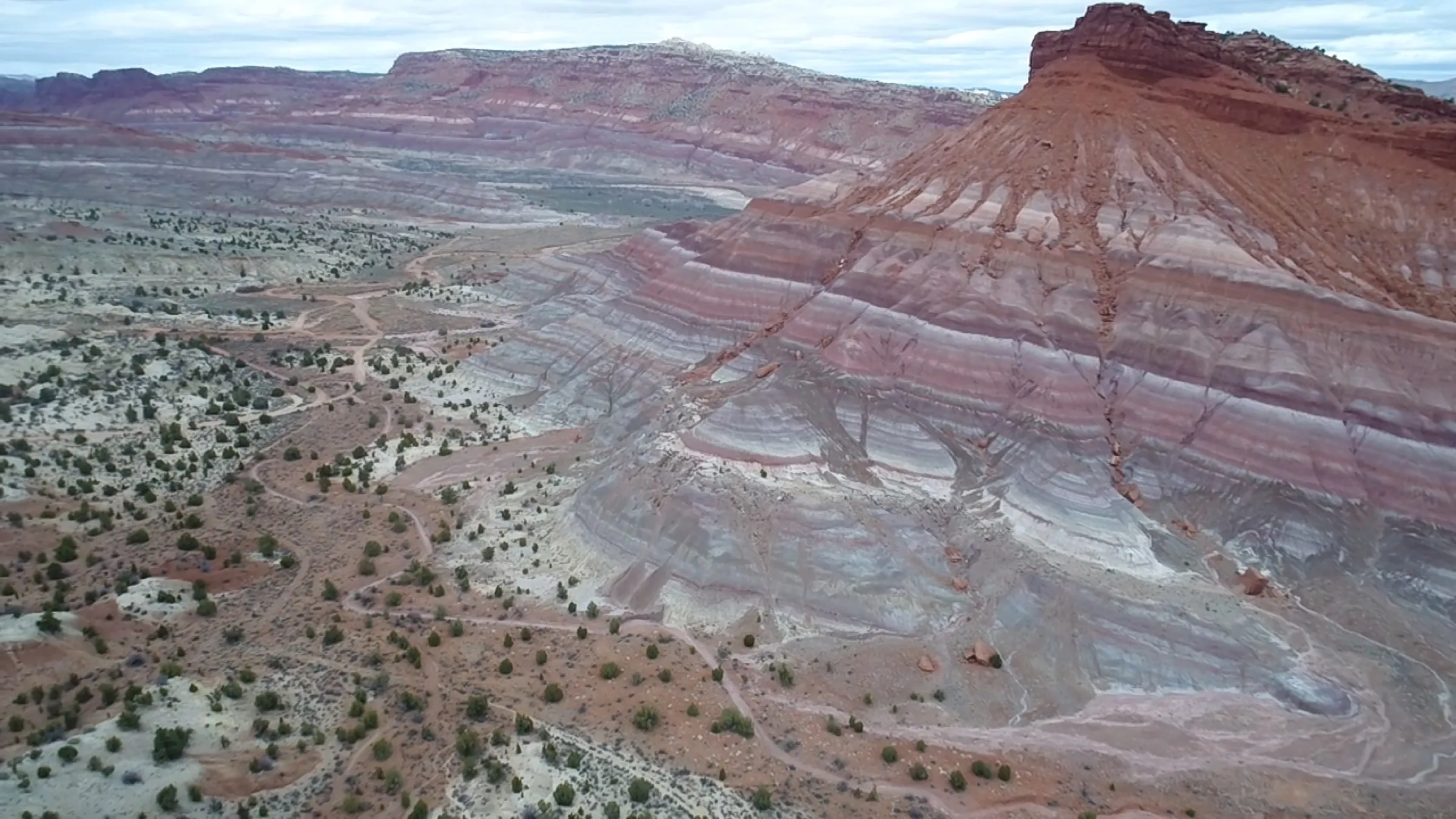
Life leaves chemical traces in rocks. Molecules and isotope ratios get locked into sediments, and in principle they tell us what was alive, what the environment looked like, and how both changed over time. The catch is that those signals are complicated, and also get altered after burial. We work on understanding what information it is possible to capture and transmit through the geological record.
We do this through a mix of fieldwork, lab experiments, and modeling.
Modern environments
We study places where biology and geochemistry are actively producing the same kinds of signatures we find in the rock record. High-altitude saline lakes, for instance, have water chemistry and microbial communities that produce sedimentary deposits that look like environments we see in ancient rocks. Watching these systems in real time gives us ground truth for interpreting the past.
Ancient environments
We extract organic molecules and measure isotope ratios in sedimentary rocks to reconstruct what depositional settings looked like and what was living in them. The goal is to make inferences about ancient biology and environments, and try to understand how life has changed over geologic time.
Lab experiments
In the lab, we grow organisms under controlled conditions and measure the molecular and isotopic signatures they produce. This tells us what specific metabolisms might look like in the rock record, so we’re not just guessing from field data alone.
Modeling
We build quantitative models that combine field and experimental data. These help us identify which chemical patterns are robust recorders of biology, which ones are overprinted by diagenesis, and how confident we should be in any given interpretation.